



499+ Happy Customers & Millions Saved in Fines
Thousands of landlords are facing strict new rules and costly penalties for not meeting MEES compliance standards. Our energy experts help you understand exactly where your property stands and what you need to do before enforcement begins.
Get a free, no-obligation consultation today and find out how to stay compliant, increase your property value, and avoid unnecessary upgrade costs.



Mixed-use properties can create some of the most confusing EPC and MEES compliance situations for UK landlords. A single building might have a shop on the ground floor, flats above, a rear office, separate entrances, separate leases, shared services, different meters, different tenants and different energy assessment requirements. On paper, it may look like one property. For EPC and MEES purposes, it may need to be treated as more than one part.
That matters because the Minimum Energy Efficiency Standards, usually called MEES, affect both domestic and non-domestic rented properties. The issue for mixed-use landlords is not only whether the building has an EPC. The real question is whether the correct type of EPC has been produced, whether each let part is compliant, whether the commercial and residential sections have been assessed properly, and whether the landlord has a realistic plan before the 2030 compliance pressure increases further.
If you own a shop with flats above, a commercial unit with residential accommodation, a converted building, a mixed office and residential block, or a property split into different uses, you should not assume one EPC automatically solves the whole building. In many cases, mixed-use properties need a more careful compliance review. That is where a proper MEES audit, EPC check and evidence pack can protect you from expensive mistakes.
At MEESCompliance.co.uk, we help landlords, property owners, agents and commercial property managers understand where their property stands today and what action is needed next. If you are unsure whether your building needs a domestic EPC, commercial EPC, exemption review or upgrade plan, you can start with our MEES compliance checker or request direct support through our contact page.
Yes, mixed-use properties may need MEES compliance checks if any part of the building is privately rented and legally requires an EPC. The complication is that different parts of the same building may fall under different EPC and MEES rules.
For example, a shop with a flat above may involve:
• A commercial EPC for the shop
• A domestic EPC for the flat
• Different lease arrangements
• Different improvement responsibilities
• Different exemption routes
• Different levels of compliance risk
A landlord who only checks one part of the building may miss a problem in another part. This can become especially risky where a commercial unit is let separately from residential flats, or where the building has been converted over time without a clean compliance structure.
If your property has both residential and commercial use, the safest first step is to review the existing EPCs and leases. Our MEES audit service is designed for exactly this type of situation because it looks beyond the headline EPC rating and checks what action is actually needed.
A mixed-use property is a building or site that contains more than one type of use. In the MEES and EPC world, this usually means a property that includes both residential and commercial elements.
Common examples include:
• A retail shop with one or more flats above
• A takeaway, café or restaurant with residential accommodation upstairs
• A high street unit with offices at the rear and flats above
• A converted house split into flats and a small office
• A building with a commercial ground floor and residential upper floors
• A warehouse with office space and caretaker accommodation
• A mixed-use investment building with multiple leases
• A property where part is owner-occupied and part is rented out
These properties often appear simple until the landlord tries to renew a lease, refinance, sell, rent out a flat, update an EPC or prepare for future MEES requirements. That is when the questions begin.
Does the whole building need one EPC? Does the flat need a separate domestic EPC? Does the shop need a non-domestic EPC? Is the landlord responsible for improving the commercial unit, the residential part or both? Can the cost cap apply? Can an exemption apply? Should the landlord improve the shared fabric of the building before replacing heating or lighting?
These are not small details. They can affect the legal ability to let the property, the cost of improvements, the sale value, the tenant negotiation, and the long-term compliance route.
Many mixed-use compliance problems start because the landlord has an EPC but not necessarily the right EPC for the right part of the building.
A common mistake is assuming that because an EPC exists, the property is covered. In reality, an EPC may relate only to one part of the building. A commercial EPC may cover the shop, while the flat above may need a separate domestic EPC. In another case, a residential EPC may exist for the upstairs flat, but the commercial unit below may be missing a valid non-domestic EPC.
Another common issue is old EPC data. An EPC might have been produced years ago before changes to the building layout, heating system, insulation, lighting, access or tenancy structure. If the building has been altered, split, extended or converted, the previous EPC may no longer give the landlord the level of comfort they think it does.
This is why landlords should not only ask, “Do I have an EPC?” A better question is, “Does each rented part of my mixed-use property have the correct EPC and a realistic MEES compliance pathway?”
If the answer is unclear, use the EPC rating update service to review whether your current EPC still reflects the property accurately.
A shop with a flat above is one of the most common mixed-use examples. It is also one of the easiest to misunderstand.
The shop is normally a commercial part of the building. If it is rented out as a retail, office, food, salon or other commercial unit, it may require a commercial EPC and must be considered under non-domestic MEES rules.
The flat above is normally residential. If it is rented as a home, it may require a domestic EPC and must be considered under domestic MEES rules.
The problem is that both parts may be physically connected but legally and functionally separate. There may be a separate entrance to the flat, separate meters, separate leases and separate tenants. There may also be shared roof space, shared walls, shared heating pipework, shared communal areas, or improvement measures that affect both parts.
For example, loft insulation may primarily benefit the flat. Shopfront glazing may affect the commercial unit. Wall insulation may affect the whole structure. Heating upgrades may depend on whether systems are separate or shared. Lighting upgrades may help the commercial EPC but have little relevance to the residential EPC. This is why mixed-use landlords need a tailored review, not generic advice.
If your ground floor is commercial, our Commercial EPC services can help you understand the non-domestic side. If the upper floors are residential, our Domestic EPC service can help check the residential position.
A mixed-use property may need more than one EPC where parts of the building are designed, used, let or sold separately. This is especially common where residential and commercial parts have different access, occupation and lease arrangements.
A landlord might need:
• A domestic EPC for a self-contained flat
• A commercial EPC for a shop, office, restaurant or warehouse unit
• A separate EPC for each separately let unit
• A new EPC after major improvements or layout changes
• A specialist review where the property has shared services or unusual construction
This matters because the wrong EPC route can produce misleading advice. A domestic EPC and commercial EPC are not the same product. They use different assessment approaches and are designed for different property types. If the wrong assessment is used, the landlord may spend money on upgrades that do not properly support compliance.
For landlords planning improvements before 2030, this is critical. A mixed-use property can easily become expensive if works are done in the wrong order. Before spending heavily on insulation, heating, windows, ventilation, air conditioning, solar or lighting, landlords should understand which part of the property is actually causing the compliance risk.
Our EPC improvement cost calculator can give a first estimate, but mixed-use properties should usually be reviewed properly before a landlord commits to major works.
The 2030 direction of travel makes mixed-use properties more important. Landlords are already thinking about EPC C, future standards, upgrade costs, exemption evidence and whether their property will remain lettable.
For a straightforward single flat, the process may be relatively clear: check the EPC, identify the rating, review recommended measures, estimate cost, complete improvements, then reassess. For a mixed-use property, the route can be more complicated. One part of the building may be compliant while another part is at risk. A landlord might improve the flat but ignore the shop. Or they might upgrade the commercial unit but leave the residential part below future expectations.
This creates three key risks.
First, the landlord may underestimate the number of EPCs or assessments needed.
Second, the landlord may underestimate the total cost because improvements may be required across more than one part of the building.
Third, the landlord may fail to keep evidence showing which improvements were made, when they were completed, what they cost, and which part of the property they relate to.
This is why we strongly recommend a compliance-first approach. Before making upgrades, create a clear record. Your compliance file should explain the property layout, tenancy structure, EPC position, improvement plan, quotes, invoices, assessor notes and exemption considerations if relevant.
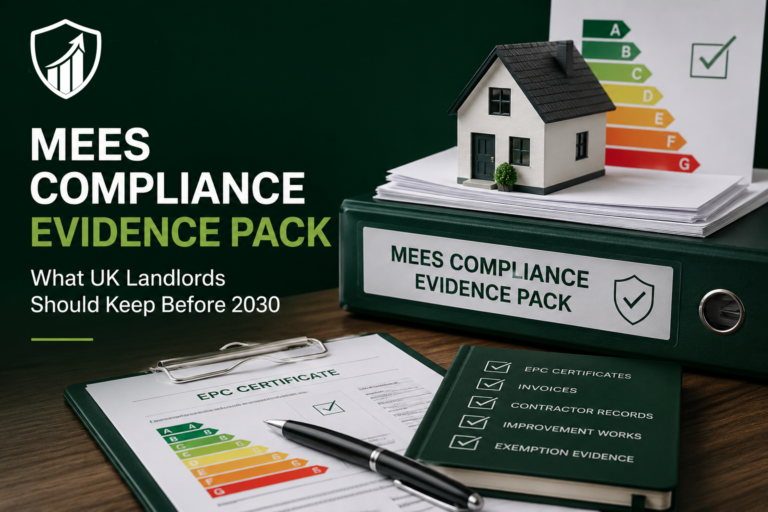
Our guide to the MEES compliance evidence pack for landlords explains why documentation is becoming just as important as the improvement work itself.
This is one of the most important questions for mixed-use landlords.
If the commercial unit is compliant but the residential flat is not, the landlord may still have a compliance problem for the residential part. If the flat is compliant but the shop is not, the commercial lease may create a separate issue. The compliant part does not automatically fix the non-compliant part.
For example, imagine a building with a ground floor retail shop and two flats above. The flats have EPC C ratings, but the shop has a poor commercial EPC. The landlord may feel the property is generally in a good position, but the commercial element may still need attention. The opposite can also happen. A renovated shop may have a decent rating, while the older flats above remain EPC D, E, F or G.
This becomes important during lease renewals, refinancing, sale due diligence, insurance checks, property management reviews and future upgrade planning. A buyer, lender, solicitor, agent or tenant may ask questions that expose the weak part of the building.
If you are already dealing with a low rating, read our guide on how to improve an EPC rating from D to C and our more specific article on what to do if your EPC rating is D.
A landlord owns a small high street building. The ground floor is let to a local convenience shop. Above the shop are two rented flats with a separate entrance at the rear.
The landlord believes the building is covered because an EPC was produced several years ago. After reviewing the paperwork, it becomes clear that the EPC only relates to one flat. The second flat has no current EPC, and the commercial shop has a separate old commercial EPC that no longer reflects the property because the heating and lighting have changed.
The landlord’s original plan was to spend money on new residential windows. However, after reviewing the building properly, the biggest compliance weakness was actually a combination of poor insulation in the residential roof space and outdated lighting in the commercial unit.
A better route was created:
• Update the domestic EPC position for both flats
• Review the commercial EPC for the shop
• Separate the residential and commercial improvement priorities
• Complete the quickest high-impact measures first
• Keep invoices, photos and assessor notes in one evidence file
• Reassess after works to confirm the improved position
The key lesson is simple. The landlord nearly spent money in the wrong order because they were looking at the property as one building, not as separate compliance zones.
A property investor buys an older building that was originally used as offices. Part of the building has been converted into residential accommodation, while another section remains as office space.
The investor wants to prepare the property for long-term rental income before 2030. The problem is that the building has a mix of old services, partial insulation, uncertain EPC coverage and unclear improvement priorities.
A proper MEES review identifies that the office space needs commercial EPC attention, while the residential units need separate domestic EPC checks. The investor also needs to think carefully about shared heating, access routes and whether building fabric improvements can improve more than one part at the same time.
Instead of treating this as a simple EPC booking, the property is reviewed as a staged compliance project. The plan separates short-term actions from long-term upgrade decisions. Lower-cost measures are completed first, while larger works are aligned with planned refurbishment and tenancy dates.
This is where portfolio compliance management becomes valuable. Mixed-use buildings are often held by landlords who own more than one property, and a single spreadsheet is not enough when deadlines, EPC expiry dates, exemptions, improvement costs and reassessments all need to be tracked.
Mixed-use landlords should keep stronger records than they think they need. This is because mixed-use properties are more likely to involve questions about responsibility, evidence and which part of the property was assessed or improved.
A good MEES compliance file should include:
• Current EPC certificates for each relevant part of the property
• Floor plans or layout notes showing the split between uses
• Lease documents showing which areas are rented and to whom
• Photos of key building features before and after improvements
• Quotes from contractors and energy specialists
• Invoices for completed energy efficiency works
• Assessor recommendations and correspondence
• Notes explaining why certain works were or were not practical
• Evidence for any exemption route being considered
• Dates of reassessment and future review reminders
If works are being planned around the cost cap, landlords should also understand what may count toward the cap and what may not. Our guide on what counts toward the MEES cost cap is a useful next step if you are already collecting quotes or planning upgrades.
In some cases, an exemption may be relevant, but landlords should be careful. Exemptions are not a casual workaround. They depend on the circumstances, the type of property, the evidence available and the correct registration route.
Mixed-use properties may raise exemption questions where:
• Improvement works require third-party consent
• The building is leasehold and the landlord does not control all parts
• The property has heritage or planning restrictions
• The recommended works are not cost-effective
• The required improvements could damage the building
• The cost cap has been reached for the relevant property or part
• Access or tenant consent creates a practical barrier
The important point is that an exemption must be properly evidenced. A landlord should not simply decide that a property is exempt without keeping records and following the correct process.
If you think your mixed-use property may qualify for an exemption, use our MEES exemption eligibility checker or read our detailed MEES exemptions guide for UK landlords. For direct help, our MEES exemptions service can support landlords with the evidence route.
The commercial part of a mixed-use property should not be ignored. Commercial MEES risk can be more serious, especially where the property is used for offices, retail, hospitality, healthcare, industrial, storage or other business purposes.
Commercial EPCs can be more technical than domestic EPCs, particularly for larger or more complex buildings. Heating, cooling, lighting, ventilation, glazing, building fabric and controls can all affect the rating. A small change in use or specification can change what the assessor needs to consider.
If your mixed-use building includes a commercial unit, you should review the commercial side early. Do not wait until a lease renewal, tenant change, refinancing process or sale exposes the issue. Our Commercial EPC services help landlords understand the non-domestic EPC position and what improvements may be required.
For landlords with larger commercial exposure, our article on Commercial EPC B by 2030 explains why commercial property owners should not leave compliance planning until the last minute.
The best way to approach a mixed-use building is not to guess. It is to create an EPC improvement plan that separates the building into logical parts and prioritises works based on compliance impact, cost, practicality and timing.
A strong mixed-use EPC improvement plan should answer:
• Which EPCs currently exist?
• Are they domestic, commercial or both?
• Which parts of the property do they cover?
• Are any EPCs missing, old or likely to be inaccurate?
• Which parts of the property are below the target rating?
• Which improvements are likely to create the biggest rating improvement?
• Which works affect only one unit and which affect the whole building?
• What should be done first?
• What evidence should be kept?
• When should the property be reassessed?
This is exactly why our EPC improvement plans are designed to go beyond basic advice. For mixed-use landlords, the objective is not simply to spend money. The objective is to spend the right money in the right order and prove the compliance position afterwards.
Waiting until the last moment can create several problems for mixed-use landlords.
Contractors may become more expensive as more landlords rush to improve properties. EPC assessors may become busier. Good installers may have longer waiting times. Tenants may make access harder. Lease events may force quick decisions. Buyers may use EPC risk to renegotiate. Lenders may ask more questions. Agents may struggle to market parts of the property if the compliance position is unclear.
For a simple flat, delay is already risky. For a mixed-use property, delay is worse because there are more moving parts. You may need more than one assessment, more than one quote, more than one improvement route, and more than one final check.
If you own a mixed-use property with any part currently rated EPC D, E, F or G, do not leave it until the market becomes crowded. Start by checking your risk using the MEES fine risk calculator and then move into a proper review if the property looks exposed.
MEESCompliance.co.uk helps landlords, agents, commercial property owners and portfolio managers understand EPC and MEES risk before it becomes expensive.
For mixed-use properties, we can help with:
• Domestic EPC support for flats and residential parts
• Commercial EPC support for shops, offices and non-domestic areas
• MEES audits to review the whole compliance position
• EPC improvement plans to prioritise practical upgrades
• Exemption guidance where improvement works may not be possible
• Evidence packs to keep compliance records organised
• Portfolio compliance support for landlords with multiple properties
• EPC reassessment guidance after improvements
• Clear next steps before lease renewals, sales, refinancing or 2030 planning
If you need a full review, start with our MEES audit service. If your property already has a low rating and you want to estimate upgrade costs, use our EPC improvement cost calculator. If you are not sure which service you need, visit our services page or contact us directly through MEESCompliance.co.uk/contact.
Mixed-use properties are valuable, flexible and often attractive to investors, but they can also create EPC and MEES complications that standard landlord advice does not cover properly.
A shop with flats above is not just a shop. A commercial unit with residential accommodation is not just a commercial EPC issue. A converted building is not always straightforward. Each part may have its own assessment route, compliance risk, improvement cost and evidence requirement.
The landlords who handle this properly will be in a stronger position before 2030. They will know which EPCs they need, what each certificate covers, which parts of the building create risk, what improvements should be prioritised, and what evidence should be kept.
The landlords who guess may spend money in the wrong place, miss part of the building, misunderstand exemption rules or discover too late that one section of the property is not as compliant as they believed.
If you own a mixed-use property, the practical next step is simple: check the EPC position now, review the MEES risk properly, create a clear improvement plan, and keep the evidence before the pressure increases.
Clear answers for landlords who own shops with flats above, commercial units with residential areas, converted buildings or properties with both domestic and non-domestic EPC requirements.
Yes. If any part of a mixed-use property is privately rented and legally requires an EPC, MEES rules may apply. The key issue is that the commercial and residential parts may need to be assessed separately. A shop may need a commercial EPC, while the flat above may need a domestic EPC.
Not always. A shop with flats above may need more than one EPC, depending on how the building is arranged, accessed, leased and used. The shop will usually be treated as a commercial space, while the flats may need separate domestic EPCs.
A mixed-use property may need a domestic EPC, a non-domestic EPC, or both. Flats, maisonettes and homes usually need domestic EPCs. Shops, offices, restaurants, warehouses and commercial units usually need non-domestic EPCs. The correct route depends on the actual use and lease structure of the property.
Yes. Each relevant part of the building should be checked on its own facts. A commercial unit may have a good EPC rating while the flat above is below target, or the residential part may be compliant while the shop or office creates non-domestic MEES risk.
Mixed-use properties are higher risk because there may be separate leases, separate tenants, separate meters, different assessors, shared building fabric and different improvement responsibilities. Without a proper review, landlords can easily miss one part of the building or spend money on the wrong upgrade first.
The non-compliant part may still create a legal and commercial risk. For example, if the shop is compliant but the rented flat above has a weak EPC rating, the landlord may still need to deal with the residential EPC issue. One compliant area does not automatically protect the whole building.
Landlords should not guess. The best route is to review each EPC, check which part creates the greatest compliance risk, compare likely upgrade costs and prioritise works that create the strongest rating improvement. In some buildings, fabric upgrades may help more than one part of the property.
Possibly, but only where the correct conditions and evidence apply. Mixed-use properties may raise exemption issues involving cost caps, third-party consent, leaseholder restrictions, planning limits or building constraints. Any exemption route should be properly evidenced and registered before being relied on.
Landlords should keep current EPCs, layout information, lease details, assessor recommendations, contractor quotes, invoices, photos of completed works, exemption evidence and reassessment records. For mixed-use properties, clear evidence is important because different parts of the building may have different compliance routes.
MEESCompliance.co.uk can help review your domestic and commercial EPC position, identify which part of the building creates risk, prepare a MEES audit, plan practical upgrades, check exemption options and organise evidence so you have a clear compliance pathway before 2030.
Get a clear MEES review before you spend money on the wrong improvements.
Enter your email address below and subscribe to our newsletter